Publications & Research
Explore our team's contributions to the field of immersive technologies, interactive media, and future realities. Our research spans virtual reality, educational technology, autonomous systems, and human-computer interaction.
LexiLearn: Adaptive AI-Driven Virtual Reality for Multisensory Literacy Instruction and Pedagogical Support
Immersive Learning Research – Practitioner, 1(1)
A journal article presenting LexiLearn, an adaptive AI-driven VR environment for early literacy education. The system integrates multisensory instruction — combining visual, auditory, and haptic cues — with generative AI scaffolding that dynamically responds to each learner's progress, alongside a teacher dashboard for real-time pedagogical support.
Implementing IVR for family therapy training: a prototype for first family therapy sessions
Frontiers in Virtual Reality, Volume 7 — Virtual Reality and Human Behaviour
A perspective article exploring how immersive virtual reality can enhance family therapy training. The authors present an IVR prototype simulating a first family therapy session, linking the technology's pedagogical affordances — embodied perspective-taking, emotional safety, standardization, and repeatability — to core family therapy competencies. Preliminary feedback from professionals indicates IVR can foster engagement and self-reflexivity.
Integrating AI in VR for Real-Time Assessment and Pedagogical Recommendations
Miami XR 2026, University of Miami
A framework for integrating generative AI into VR to enable continuous learner assessment and adaptive pedagogical recommendations. Validated through LexiLearn, a literacy VR application featuring synchronized visual, auditory, and haptic feedback with an AI-powered teacher dashboard.

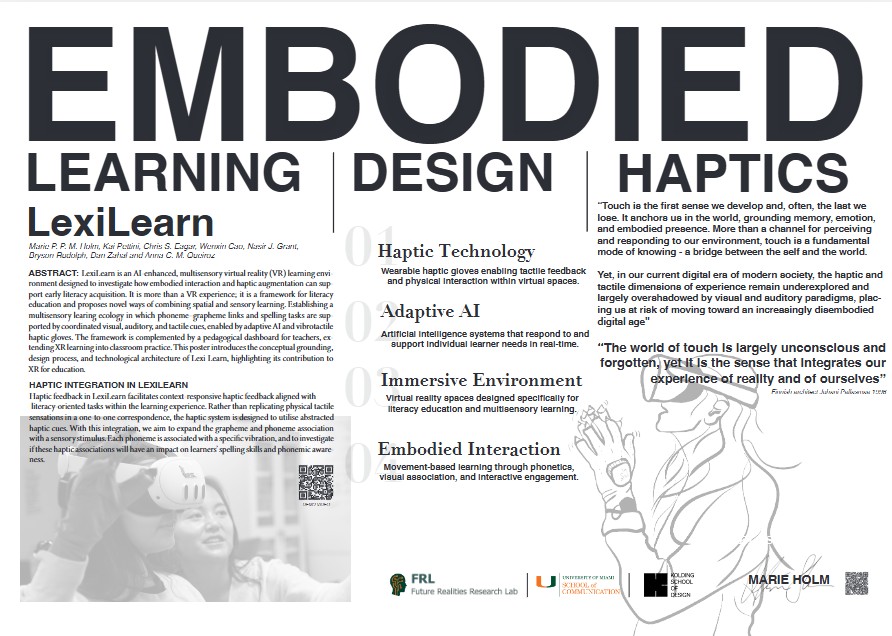
Embodied Learning, Design, and Haptics: LexiLearn
Miami XR 2026, University of Miami
LexiLearn is an AI-enhanced, multisensory virtual reality learning environment investigating how embodied interaction and haptic augmentation support early literacy acquisition. The framework combines spatial and sensory learning through coordinated visual, auditory, and tactile cues enabled by adaptive AI and vibrotactile haptic gloves.
Fostering Climate (In)Justice Awareness through A Multiplayer Mixed Reality Game
Miami XR 2026, University of Miami
This project designs a multiplayer mixed reality application for climate justice communication, using spatial animation for multi-user simulations with strategies regarding economic and environmental conflicts. Three participants interact with a shared virtual environment representing territories with different economic resources and climate vulnerabilities.

Adaptive Self-Efficacy–Based AI Coaching for Enhanced Indoor Cycling Performance: A Personalized Machine Learning Approach
Miami XR 2026, University of Miami
This IRB-approved randomized controlled trial investigates whether adaptive AI coaching enhances cycling performance compared to static coaching and control conditions. Using a contextual bandit algorithm, the system delivers personalized affirmations based on real-time physiological data during a 20-minute time trial.

LexiLearn: Sensory AI-enhanced VR Integration for Literacy Skills Acquisition
General Proceedings of the ISLS Annual Meeting 2026 (pp. 35–39), International Society of the Learning Sciences
An AI-enhanced VR learning experience for early literacy that pairs adaptive, generative AI scaffolding with wearable haptic gloves and handheld controllers. Set in a calm, nature-inspired virtual orchard, the system synchronizes visual, auditory, and vibrotactile cues to support phoneme–grapheme recognition and spelling, while a companion teacher dashboard translates learner data into actionable classroom insights.
Self-review and feedback in virtual reality dialogues increase language markers of personal and emotional expression in an empathetic communication training experience
Computers & Education: X Reality, 7
This empirical study demonstrates how self-review and feedback mechanisms in virtual reality dialogues enhance language markers of personal and emotional expression in empathetic communication training experiences. The research provides evidence for the effectiveness of reflective practice in VR-based learning environments.
Virtual Exchange, Virtual Reality, and Conversational Artificial Intelligence in Global Health Courses: Building Empathy and Understanding in Humanitarian Response
International Virtual Conference Exchange, Greece
This study explores how virtual exchange, virtual reality, and conversational AI can be integrated in global health education to build empathy and understanding of humanitarian response. The research demonstrates innovative approaches to cross-cultural learning and global health training.
How do immersive technologies influence cognitive load, memory retention, and knowledge transfer? Evidence from a multilevel meta-analysis
75th International Communication Association Conference, Denver, USA
A comprehensive multilevel meta-analysis examining the impact of immersive technologies on cognitive load, memory retention, and knowledge transfer processes. This research synthesizes findings from multiple studies to provide robust evidence about learning outcomes in immersive environments.
Predicting and Understanding Turn-Taking Behavior in Open-Ended Group Activities in Virtual Reality
28th ACM SIGCHI Conference on Computer-Supported Cooperative Work & Social Computing (CSCW), Norway
This research investigates turn-taking behavior patterns in open-ended group activities within virtual reality environments, providing insights for collaborative VR design. The study offers empirical evidence for designing more effective social VR experiences.
An interactive-participatory session for exploring the potential of Immersive Virtual Reality for family therapy
EFTA-RELATES 2025, France
An innovative interactive-participatory session design that explores the potential of immersive virtual reality applications in family therapy contexts through collaborative inquiry methodologies. This work bridges clinical practice with emerging technology research.
Injecting hallucinations in autonomous vehicles: A component-agnostic safety evaluation framework
arXiv
This research presents a component-agnostic safety evaluation framework for autonomous vehicles, focusing on injecting and analyzing hallucinations to assess system robustness and safety protocols. The work contributes to understanding and improving the reliability of autonomous systems.